Should the USA Plant More Moringa for Global Needs?
Environment, Global Nutrition, Sustainable Agriculture
Does the USA Need to Plant More Moringa for a Global Market?
Imagine a single crop that can fight malnutrition, withstand drought, and slot seamlessly into climate-smart farming systems—all while feeding a fast-growing global wellness market. That crop already exists, and it’s not some futuristic lab invention. It’s moringa, the so‑called “miracle tree,” long cultivated in parts of Asia, Africa, and Latin America.
As demand for nutrient-dense, sustainable crops accelerates worldwide, moringa keeps moving from niche ingredient to mainstream staple. The real question now is not whether moringa has potential—but whether the United States should plant far more of it to help power a truly global market.
Why Moringa Matters to the Global Market
Moringa oleifera is prized for its exceptional nutritional profile . Its leaves contain protein, vitamins A, C, and E, calcium, potassium, and a range of antioxidants. In powdered form, it is used in smoothies, nutrition bars, supplements, teas, and even fortified foods aimed at combating malnutrition. As health-conscious consumers around the world look for functional foods, moringa’s reputation continues to grow.
At the same time, moringa is valued by development organizations as a resilient crop . It tolerates drought, grows quickly, and can be harvested multiple times a year in suitable climates. That combination of nutrition and resilience makes it attractive not just for premium wellness products, but also for food security initiatives in vulnerable regions.
To dive deeper into how moringa stacks up against other climate-resilient crops, see our related guide, Moringa vs. Other Superfoods: Nutrition, Yield, and Climate Impact.
Current Supply: Concentrated Outside the United States
Today, most of the world’s commercial moringa comes from countries such as India, the Philippines, and several African nations. These regions offer warm climates and lower labor costs, which have helped them dominate production of dried leaves, seed oil, and value-added products. The United States, by contrast, plays a relatively small role, with moringa mostly grown on niche farms in states like Florida, Texas, California, Arizona, and Hawaii.
However, demand for moringa-based products is no longer confined to local markets. Global brands in Europe, North America, and Asia are incorporating moringa into their portfolios. This raises a strategic question: should the USA step up and plant more moringa to serve this expanding global market, or remain a minor player dependent on imports?
For a closer look at how international supply chains are evolving, you may also like Global Moringa Supply Chain Trends and What They Mean for US Growers.
The Case for Planting More Moringa in the USA
1. Supporting Global Nutrition and Food Security – By cultivating more moringa, American growers could contribute to a more stable, diversified global supply. US-grown moringa could be processed domestically and exported as leaf powder, capsules, and fortified ingredients to regions where reliable, high-quality supply is needed for nutrition programs and health-focused products.
2. Reducing Supply Chain Risks – The pandemic and recent geopolitical tensions have highlighted how fragile long-distance supply chains can be. Concentrating moringa production in a few countries leaves brands vulnerable to weather shocks, export restrictions, or logistical disruptions. Expanding cultivation in the USA would help diversify production and make the global moringa market more resilient.
3. Meeting Premium Market Expectations – Many consumers in Europe and North America are willing to pay more for products that are traceable, certified, and produced under stringent quality standards. US farms, with established food safety regulations and certification systems, are well positioned to supply high-end moringa ingredients to global buyers looking for reliability and transparency.
4. New Opportunities for Farmers in Warmer States – As climate patterns shift, growers in the southern United States are exploring alternative crops that can handle heat and unpredictable rainfall. Moringa, when carefully managed, could fit into diversified production systems alongside fruits, nuts, and specialty vegetables, offering a new income stream linked directly to international demand.
If you’re evaluating moringa alongside other specialty crops, check out Profitable Specialty Crops for Warm-Climate Farms for a broader comparison.
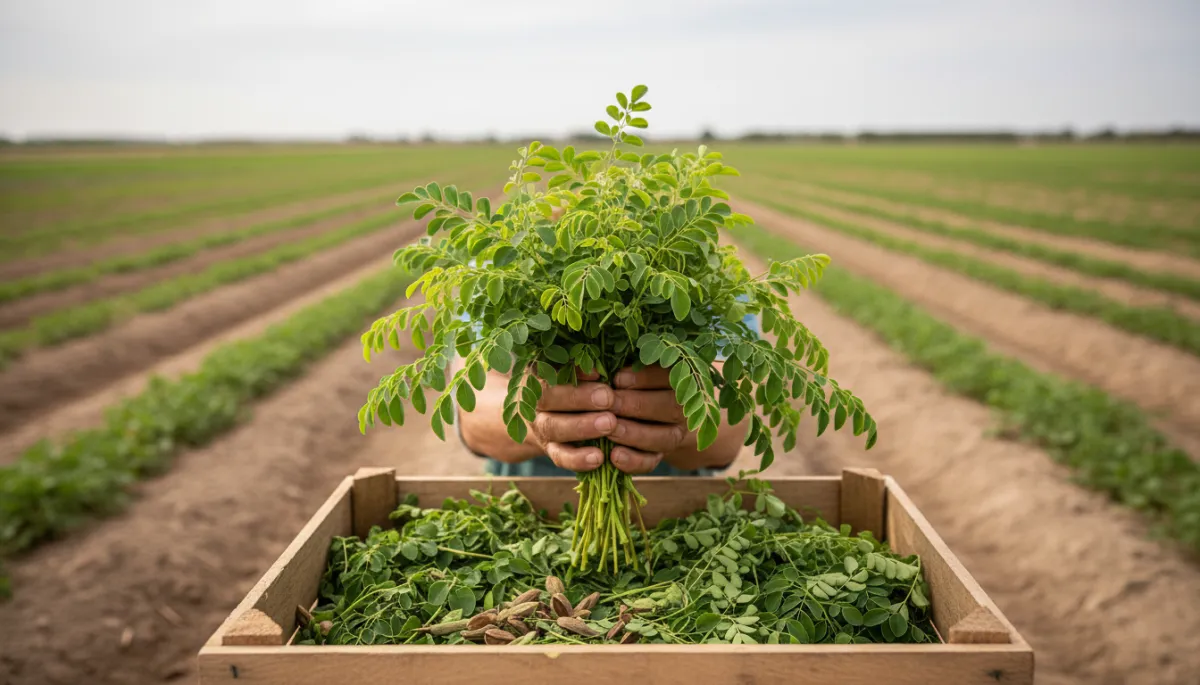
Carefully managed US moringa crops could serve both domestic wellness brands and export buyers.
Environmental and Agricultural Advantages
Beyond nutrition and trade, moringa offers environmental benefits that align with broader sustainability goals. The tree’s deep roots help stabilize soil and reduce erosion, while its fast growth and leafy canopy can contribute to carbon sequestration. In agroforestry systems, moringa can be intercropped with other species, providing shade and organic matter that improve soil health over time.
In semi-arid parts of the southern USA, moringa could become part of climate-smart agriculture strategies. With appropriate irrigation and management, it can deliver biomass and edible leaves with relatively modest resource inputs. For a global market increasingly attentive to the carbon footprint and water use of its food, this is a persuasive selling point.
💡 Pro Tip: Position moringa not only as a “superfood,” but as a climate-resilient crop when marketing to international buyers focused on sustainability.
For more on designing whole-farm systems that prioritize resilience, see Climate-Smart Agroforestry Strategies for Small and Mid-Scale Farms.
Challenges the USA Must Consider
None of this means the United States should plant moringa indiscriminately. The tree is sensitive to frost, limiting large-scale cultivation to warmer regions. Farmers will need access to reliable agronomic knowledge , from pruning and harvesting techniques to pest management and post-harvest handling, to ensure consistent quality that meets global standards.
There is also the question of market coordination . To truly target the global market, US growers will need processing facilities, export channels, and partnerships with brands that can absorb volume. Without this coordination, isolated farms may struggle to compete with established producers overseas who benefit from lower costs and existing buyer relationships.
We unpack these operational hurdles in more detail in From Field to Finished Product: Moringa Processing and Market Access.
So, Does the USA Need to Plant More Moringa?
Taken together, the evidence points toward a clear answer: yes, the USA should plant more moringa , but in a strategic and coordinated way. Expanding cultivation in suitable regions could:
Strengthen global supply for nutrition and wellness products
Create new export opportunities for American farmers and processors
Contribute to climate-smart agriculture and soil restoration efforts
Offer global buyers a premium, traceable source of moringa ingredients
For the global market, more US-grown moringa would mean a broader, more resilient supply base and a wider range of product options. For the United States, it represents a chance to align agriculture with worldwide trends in health, sustainability, and responsible sourcing. The opportunity is there; the next step is thoughtful investment, research, and collaboration to ensure moringa takes root as a meaningful player in both American fields and international trade.
📌 Key Takeaway:Moringa offers the USA a rare triple win—supporting global nutrition, strengthening climate-smart agriculture, and opening premium export channels when growers, processors, and buyers move in sync.
In practical terms, that means starting small but planning big: pilot plantings in suitable regions, clear quality standards, and early conversations with partners who can turn leaves and seeds into export-ready products. When these pieces come together, US moringa isn’t just another niche crop—it becomes a strategic ingredient in global food, wellness, and sustainability solutions.
To connect with growers, learn best practices, or explore collaborative opportunities in the moringa space, consider joining MR MORINGA'S Grow Moringa Collective here: https://www.skool.com/grow-moringa-collective/about?ref=0c25c4cc92c3476c9b1d84ba5cf00416 .
💡 Action Step: Join the Collective this week, identify your best potential moringa acreage, and schedule a call or forum post to get feedback on your first-season plan before you plant a single tree.
If you’re ready to sketch out your own roadmap, don’t miss How to Launch a Moringa Farm in the US: Step-by-Step Planning Guide—use it alongside the Collective to move from idea to implementation with far less guesswork.
Frequently Asked Questions About Moringa Cultivation and Market Potential
📌 Key Takeaway: These FAQs address the most common questions growers, investors, and wellness brands ask when considering moringa in the United States.
1. Where in the USA can moringa be grown successfully?
Moringa thrives in warm, frost-free climates. In the United States, that typically means parts of Florida, Texas, Arizona, California, Louisiana, and Hawaii. In marginal areas that experience occasional cold snaps, growers may use strategies like planting in protected microclimates, using high tunnels, or treating moringa as a fast-growing annual rather than a long-lived tree.
For site-selection checklists and zoning considerations, see our regional planning article, Where to Grow Moringa in the US: Climate Zones and Microclimates.
2. How long does it take for moringa to become harvest-ready?
Under good conditions, moringa is remarkably fast-growing. Farmers can often begin harvesting tender leaves within 3–6 months of planting. With proper pruning and management, the same trees can provide multiple flushes of leaves per year, making it attractive for both smallholders and larger commercial operations.
For a month-by-month breakdown of tasks, download the calendar in Moringa Harvest Calendar and Yield Planning for New Growers.
3. What are the main products made from moringa, and which have the strongest market demand?
The global market currently focuses on three main product categories:
Dried leaf powder for smoothies, capsules, teas, and functional foods
Moringa oil (from seeds) for cosmetics, skincare, and specialty culinary uses
Fortified ingredients used in nutrition bars, instant beverages, and foods targeting malnutrition
At the moment, leaf powder and finished dietary supplements show the strongest demand in North America and Europe, while fortified foods and community nutrition programs are key drivers in many parts of Africa and Asia.
For product developers and brand owners, we explore formulations and positioning in Building Moringa Products for the Wellness Market.
4. Is there enough global demand to justify new moringa plantations in the USA?
Current demand is driven by wellness, plant-based nutrition, and sustainability trends. While the market is still smaller than mainstream crops, it is expanding steadily as more brands add moringa to product lines. The greatest opportunities for US growers are in:
Premium, traceable, certified-organic ingredients for export and domestic brands
Long-term contracts with companies focused on health, nutrition, and climate-smart sourcing
The key is not just planting trees, but aligning production with specific buyers and product categories from the beginning.
For demand forecasts and price trends, review our market snapshot, Moringa Market Outlook to 2030.
5. What certifications or quality standards do global buyers expect?
Many international buyers look for GMP-compliant processing, organic certification, and rigorous testing for contaminants such as heavy metals, pesticides, and microbiological loads. Some markets may also require:
USDA Organic or equivalent certifications
Non-GMO and allergen-control documentation
Traceability records from field to finished product
💡 Pro Tip: Build your quality systems early. Farms that can document clean production and transparent sourcing are far more attractive to serious global buyers.
For a checklist you can use with your team, see Moringa Quality and Certification Checklist for Export-Ready Farms.
6. How does moringa fit into a diversified, climate-smart farm plan?
Moringa can serve as a multi-purpose tree on diversified farms. It can be:
Intercropped with vegetables, fruits, or herbs to provide light shade and organic matter
Pruned regularly to supply leaf biomass for mulch or animal fodder
Integrated into agroforestry and soil-restoration projects on degraded land
For growers already thinking about climate resilience, water efficiency, and long-term soil health, moringa can be a valuable component rather than a stand-alone solution.
For practical design examples, see Moringa in Regenerative Farming Systems: Real-World Case Studies.
7. How can new growers reduce risk when entering the moringa market?
The most successful moringa projects tend to:
Start small and scale up as agronomic knowledge and market channels solidify
Build partnerships with processors, brands, or cooperatives before planting large acreages
Join grower networks to share best practices, buyer contacts, and technical support
“Treat moringa as a strategic crop: align agronomy, processing, and sales from day one, rather than hoping the market will appear later.”
Communities like Kendrick Henry's Grow Moringa Collective can help new and experienced growers navigate these steps together, reducing individual risk while building a stronger, more coordinated moringa sector in the United States.
For a risk-assessment worksheet and planning template, visit Moringa Investment and Risk Planning for New Entrants.